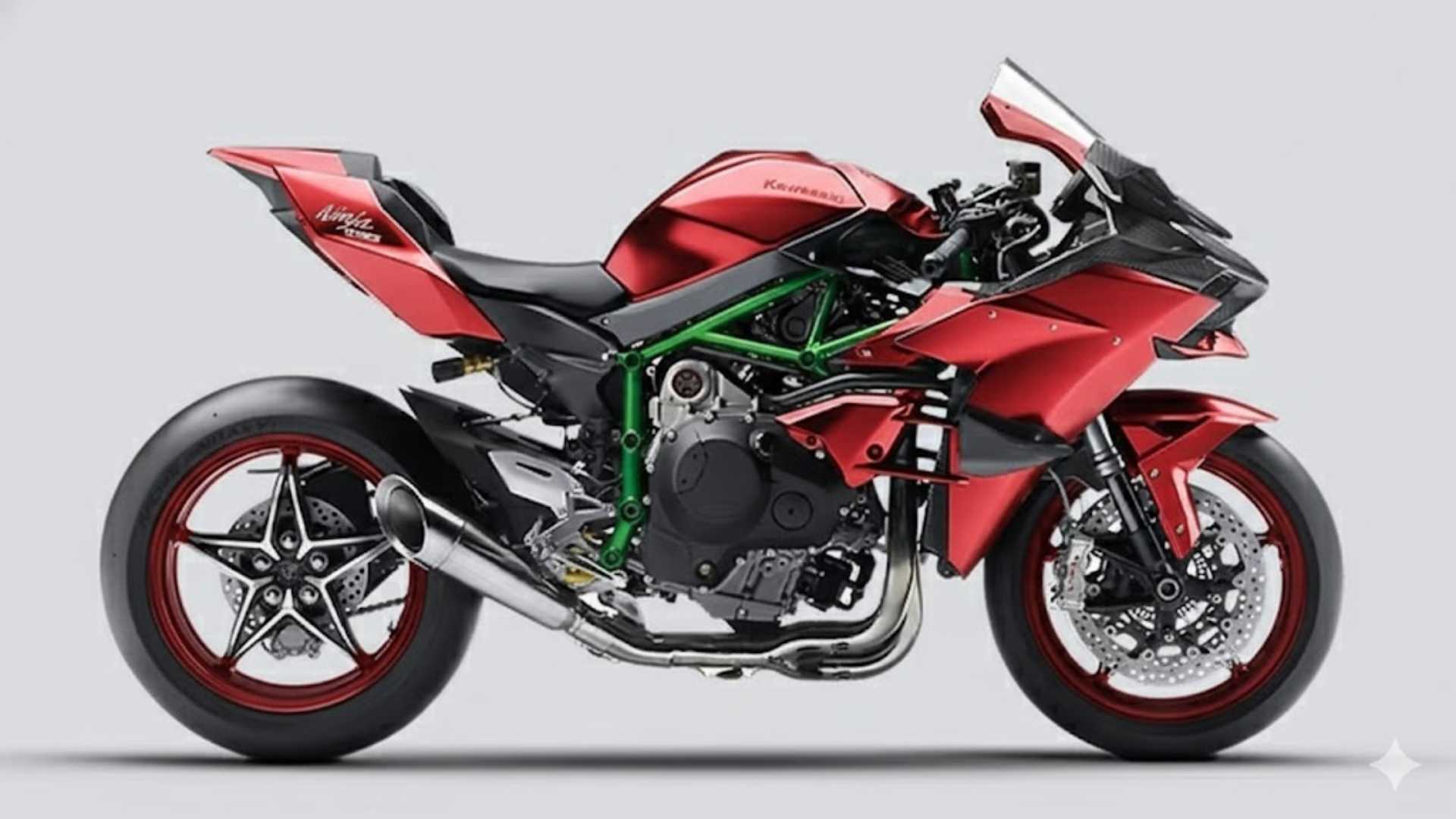
Why the Kawasaki Ninja H2 Is Not Just a Motorcycle, but a Moment in History
Kawasaki Ninja: Some machines are built to sell. Others are built to comply. And then there are machines like the Kawasaki Ninja H2, created not because the market asked for them, but because engineering ambition refused to stay quiet.
The Ninja H2 is not a response to competitors. It is not a value proposition. It is a statement of intent. Kawasaki did not set out to build the fastest motorcycle in the traditional sense. It set out to break the mental ceiling of what riders believe is possible.
| Core Snapshot | What It Reveals Instantly |
|---|---|
| Motorcycle Type | Hyperbike / Supercharged Superbike |
| Engine Philosophy | Forced induction performance |
| Target Rider | Elite enthusiasts, collectors, thrill purists |
| Core Identity | Engineering dominance over convention |
| Why It Exists | To redefine what a production motorcycle can be |
Kawasaki Ninja: The 2025 Searcher’s Curiosity: Why the Ninja H2 Still Dominates Attention
Search behavior around the Kawasaki Ninja H2 reveals something fascinating. People are not just searching for specs. They are searching for meaning.
Queries like “why Ninja H2 is special,” “supercharged motorcycle experience,” and “is Ninja H2 worth it” show that modern riders are not only curious about power. They want to understand the philosophy behind it.
In an era where many bikes feel optimized by committee, the Ninja H2 stands apart as a machine driven by obsession. That obsession is what keeps it relevant, even years after its debut.
Kawasaki Ninja The Supercharger: Where the H2 Breaks All Motorcycling Rules
At the heart of the Kawasaki Ninja H2 lies its defining feature: a mechanically driven supercharger developed entirely in-house by Kawasaki Heavy Industries.
This is not a borrowed automotive component. This supercharger was engineered specifically for motorcycle dynamics, revving to extreme speeds and delivering compressed air with surgical precision.
Unlike turbochargers, which rely on exhaust gases and introduce lag, the H2’s supercharger delivers power instantly. Twist the throttle, and reality stretches.
The sensation is not just speed. It is density. The air feels thicker. Time feels compressed.
Kawasaki Ninja: What Supercharging Really Means for the Riding Experience
Many riders assume the Ninja H2 is simply about extreme top speed. That assumption misses the point entirely.
Supercharging transforms the entire power curve. Acceleration is relentless, linear, and almost unnatural. There is no waiting for the engine to “come on cam.” Power is everywhere, all the time.
This creates a riding experience that feels more like controlling a force than riding a machine. The H2 does not ask for aggression. It demands respect.
Kawasaki Ninja Engineering Without Compromise: The Kawasaki Heavy Industries Advantage
Kawasaki’s unique position as an industrial giant gives it an advantage no other motorcycle manufacturer can match. Aerospace, energy systems, robotics, and defense engineering all feed into the Ninja H2’s DNA.
This cross-industry expertise is visible everywhere. From the precision-machined supercharger impeller to the trellis frame designed to handle extreme forces, the H2 is a masterclass in applied engineering.
This is not marketing language. It is structural reality.
Kawasaki Ninja: Frame, Chassis, and the Battle Against Physics
Containing the power of the Ninja H2 is arguably more impressive than creating it.
The high-tensile steel trellis frame is engineered to flex just enough under load, maintaining stability without becoming brittle. Swingarm geometry, suspension tuning, and wheelbase length are all calculated to keep the bike controllable at insane speeds.
Riding the H2 is like holding a wild animal on a leash that has been tested to its absolute limits.
Aerodynamics: When Wings Are Not Just for Show
One of the most visually striking elements of the Ninja H2 is its winglets. These are not decorative.
At extreme speeds, aerodynamic lift becomes a serious issue. The H2’s carbon fiber winglets generate downforce, keeping the front wheel planted during acceleration.
This is borrowed directly from aerospace principles. At full throttle, the bike is not just fast. It is aerodynamically managed.
Few motorcycles operate in a performance envelope where such measures are necessary. The H2 lives there permanently.
Kawasaki Ninja Riding Position: A Study in Controlled Aggression
The Ninja H2’s riding position is unapologetically committed. This is not a comfortable commuter. The low clip-ons, aggressive footpeg placement, and forward-leaning stance are designed for control at speed.
Yet, surprisingly, the ergonomics are not punishing. Kawasaki has balanced aggression with just enough practicality to make the bike rideable on real roads, within reason.
The message is clear. This bike is focused, but not foolish.
Kawasaki Ninja Electronics: The Only Reason the H2 Is Rideable at All
Without advanced electronics, the Ninja H2 would be unrideable for all but the most elite racers.
Traction control, launch control, engine braking management, power modes, and cornering ABS work constantly in the background. These systems are not optional luxuries. They are survival tools.
Importantly, Kawasaki tunes these aids to support the rider rather than dominate the experience. You still feel the power. You are just not overwhelmed by it instantly.
Kawasaki Ninja: The Psychological Impact of Riding a Ninja H2
Riding the Ninja H2 does something few motorcycles can. It alters perception.
After riding an H2, most bikes feel slower. Roads feel shorter. Your sense of speed recalibrates.
This is both exhilarating and humbling. Many riders report that the H2 teaches restraint rather than recklessness. When everything is available instantly, discipline becomes the true skill.
Kawasaki Ninja Case Study: Why Many H2 Owners Ride Less, But Appreciate More
Interestingly, many Ninja H2 owners ride fewer kilometers than owners of more practical bikes. Yet they describe their ownership experience as deeply satisfying.
Why? Because the H2 is not about utility. It is about significance.
Each ride feels intentional. Each moment feels special. The bike transforms riding from habit into ritual.
Ownership Reality: Cost, Maintenance, and Responsibility
There is no illusion here. The Ninja H2 is expensive to buy, insure, and maintain.
Service intervals require specialized knowledge. Tires disappear quickly under its torque. Fuel consumption is unapologetically high.
Yet, owners rarely complain. Because the value proposition is emotional, not financial.
Ninja H2 vs H2R: Understanding the Difference
The street-legal Ninja H2 is already extreme. The H2R, its track-only sibling, exists beyond that.
With even more power and fewer restrictions, the H2R is essentially a proof of concept unleashed. For most riders, the standard H2 is already beyond usable limits.
The distinction reinforces Kawasaki’s philosophy. The H2 is not the limit. It is the compromise.
Kawasaki Ninja Cultural Impact: How the Ninja H2 Changed Motorcycling Forever
Before the H2, forced induction in motorcycles was largely theoretical. After the H2, it became undeniable.
Kawasaki proved that supercharging was not just possible, but viable. It shifted industry conversations and inspired future innovation.
Even manufacturers who do not pursue forced induction must now acknowledge it.
The H2 in 2025: Still Relevant, Still Untouchable
In 2025, many superbikes match or exceed older performance benchmarks. Yet none replicate the H2’s character.
Electric motorcycles may out-accelerate it in short bursts. But they do not deliver the same mechanical drama, sound, or sensation.
The H2 remains a bridge between raw combustion and futuristic performance.
Environmental Reality and the H2’s Place in a Changing World
The Ninja H2 is not an eco-conscious machine. And it does not pretend to be.
Instead, it represents the final, glorious expression of internal combustion excess. In a future increasingly shaped by electrification, the H2 stands as a monument to what was possible.
That does not make it irresponsible. It makes it historic.
Frequently Asked Questions About Kawasaki Ninja H2
Is the Kawasaki Ninja H2 street legal?
Yes, the Ninja H2 is street legal in many markets. The H2R is track-only.
How fast is the Kawasaki Ninja H2?
Top speed figures vary by market and configuration, but the experience of acceleration matters more than absolute numbers.
Is the Ninja H2 too powerful for normal riders?
It is extremely powerful, but advanced electronics make it manageable for disciplined, experienced riders.
What makes the Ninja H2 different from other superbikes?
Its supercharged engine delivers a completely unique power delivery and riding sensation.
Is the Ninja H2 a good investment?
Financially, it is a depreciating asset. Emotionally and culturally, it holds exceptional value.
The Deeper Meaning of the Ninja H2
The Kawasaki Ninja H2 exists to challenge assumptions. That motorcycles must be reasonable. That performance must follow trends. That limits should be accepted.
It reminds us that engineering, when guided by passion rather than spreadsheets, can still shock the world.
Future Predictions: Will We Ever See Another H2?
As regulations tighten and electrification accelerates, machines like the Ninja H2 will become rarer.
It is unlikely that another manufacturer will attempt something this extreme in the same way. The H2 may remain a singular achievement.
That rarity will only increase its legend.
Next Steps: Is the Ninja H2 Right for You?
Ask yourself why you ride. If the answer is transportation, the H2 is not for you.
If the answer is experience, emotion, and the pursuit of mechanical wonder, then the Ninja H2 offers something no other motorcycle can.
Do not chase numbers. Chase meaning.